

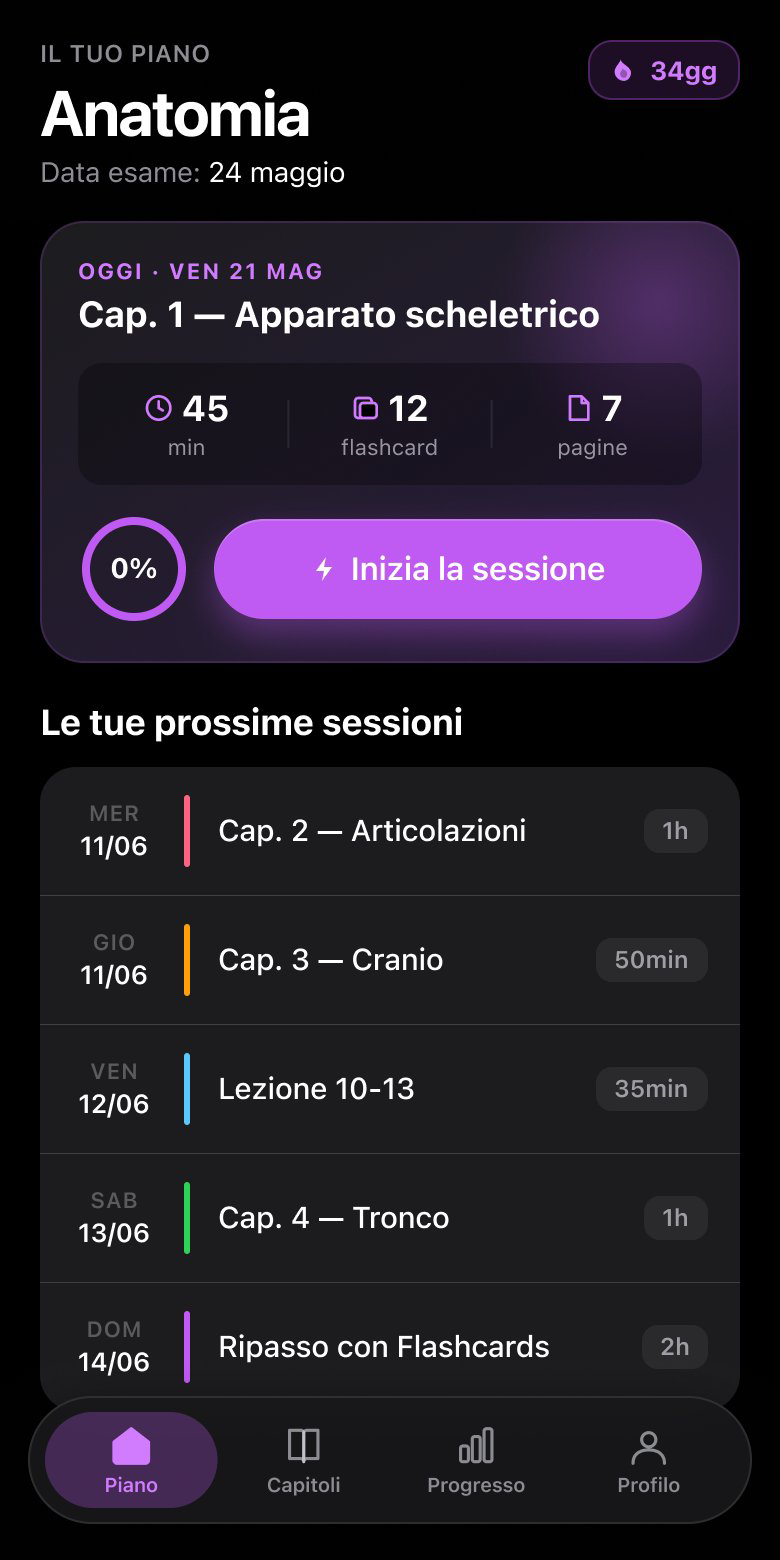
A single feature that creates the Aha! Moment in ≤5 taps.
The killer feature is the adaptive AI Study Planner. After uploading the PDF, the student enters the exam date and, in less than 60 seconds, receives a daily study plan that adjusts based on his actual progress.
STEM students waste ~4.5 hours a week on pure friction.
More than 10% of study time is spent switching between different apps — not learning. Four recurring patterns emerged from four simulated interviews conducted using the Mom Test:
Manually creating flashcards is a bottleneck. Time spent creating cards, not reviewing.
AI doesn't work without context. Generic answers that are disconnected from the actual course materials.
The DIY plan falls apart at the first hurdle. No recalculation if the timeline changes.
Study materials in WhatsApp groups get lost as you scroll.
Who do I build for (and who not).
Two personas with opposing financial situations and purchase triggers.
Giulia, 22
Pay early if you see real value: conversion within 3–5 days of use. Churn risk: billing surprise.
Matteo, 21
Pay later, driven by gamification: the free tier must be genuinely useful. Risk: app forgotten.
I have deliberately excluded high school students (the Quizlet segment) and English speakers (Vaia / RemNote) from the target audience: a defensible SOM, an underserved market (Italy < 5% of the players' MAU), and a credible GDPR/EU UX differentiator.
Two asymmetric tiers for two different emergencies.
A trust-first strategy and a contingency plan that offers certainty, not just a subscription.
This is the pre-selected anchor plan. The trial covers a real-world study cycle → conversion becomes a logical consequence.
For the student with an exam in 10 days who doesn’t want to commit to a year-long program. It doesn’t sell an app—it sells peace of mind during a high-pressure moment. Flexible time-based access replaces the trial version.
Expected blended ARPU: ~€12.6/month vs. €4.99 for the classic freemium model. Payback period 1.8 months vs. 4.4. Target mix at launch: 70% annual / 30% weekly.
Four cognitive biases used in the user's favor.
To make the rational choice clear. The paywall appears on step 13, after the student has already co-created their plan.
-
1
Loss Aversion + Zeigarnik Effect
The image appears blurry in the background: the brain perceives it as an unfinished task to be completed, not as a product to be purchased.
-
2
Hick's Law
Only 2 levels instead of the standard 3 in Vaia/Quizlet → 33% reduction in cognitive decision-making load.
-
3
Commitment + IKEA Effect
The paywall appears at step 13, after 3 minutes of engagement and the co-creation of the plan.
-
4
Clarity and transparency
Cancel in 2 taps. No charge today. Demonstrate transparency and explain how users can cancel his subscription.

−2 conversion points per tap, +30% after one month. A deliberate choice, aimed at increasing user satisfaction.
Three ways to manage risk before writing code.
Qualitative, quantitative, and market demand—each with explicit go/no-go thresholds.
Usability test
7 metrics — CES, Hesitation Index, Paywall Comprehension Score — with pass/fail thresholds for each screen. Maze.co for unmoderated testing, Lookback for think-aloud sessions.
A/B test
Paywall CTAs (“View your plan” vs “Start for free”), placement of the insight screen, and dynamic copy during loading. Sequential, never parallel.
Fake door testing
The feature remains in the backlog until TTR ≥ 18%, OIR ≥ 45%, and WTP ≥ 55% are simultaneously verified at α ≤ 0.05. Three-level decision matrix: Build / Investigate / Discard.
Three realistic scenarios.
The default launch scenario is set below the 3× threshold: this is the scenario where the budget is allocated to organic growth and retention, not to paid acquisition.
| Scenario | CAC paying | LTV | LTV/CAC | Payback | Key lever |
|---|---|---|---|---|---|
| Launch · months 0–12 | 84€ | 58€ | 0,69× | 12 months | Organic-first, no paid scaling |
| Optimization · months 12–24 | 42€ | 94€ | 2,23× | 5,6 months | Churn reduced from 12% to 8% using an adaptive planner |
| Steady state · month 24+ | 31€ | 277€ | 8,8× | 4 month | Annual renewal 71% + referral K=0,25 |
An outcome-based roadmap.
Measurable goals, not endless lists of features.
Post-launch optimization
- CAC blended −15% (→ ≤51€)
- Trial Start Rate ≥38%
- Crash-free Sessions ≥99,85%
- A/B pricing on CA + AU
Engagement & retention
- D7 Retention from 20% to 30%
- Monthly Churn from 11% to 8%
- In-app notification (Delighter)
- SRS algorithm + Plan recalculation
Expansion & Scalability
- Soft launch US (post-validation CA/AU)
- AI Voice Tutor (if Fake Door = Green)
- Study groups
- Report card and grade point average